


2. THEORETICAL FOUNDATIONS
2.3. Columns plates
2.3.4. Efficacy of real plates and plates needed
To determine the efficacy should consider the following functions:
- Design of the plates.
- Fluid Properties.
- Flow Model.
If the dishes are well designed and the flow velocity is approximately the limit of capacity, then the effectiveness depends mainly on the physical properties of fluids.
In general, the following methods used to estimate the efficacy of a given column are:
- By comparing data with other columns that are in operation in industrial plants which contain the same or systems that are similar.
- Using empirical models obtained from the data.
- Using semi-theoretical models based on mass and heat transfer.
So the efficiency can be defined as the approximation stage fractionally on the balance you get with a real dish.
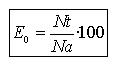
Efficiency can be calculated from the overall effectiveness of a column using the following equation:
Where:
Nt: the number of the theorical plates.
Na: the actual number of plates.
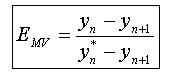
Another method is to calculate the efficiency using the efficiency of the whole plate by Murrphree, which is made with the following equation:
Where:
EMV: Murphree vapour efficiency of the stage n.
yn *: composition of the vapour in equilibrium with the liquid that exits the stage n.
There is also the option to calculate the Murphree efficiency graphically. To calculate this graphically is enough to make these calculations in three or four points and then draws a line, enter the operating line and equilibrium, in the graph, a fractionally vertical distance from the line of operation that similar to the efficiency of gas Murhpree predominant.
The value of the efficiency of vapour (EMV) the lower plate is the relationship between lines AB/AC.
The new line formed will be used to calculate the real number plates, instead of using the online operation.
 Figure 2.10: Example graphic calculation to find the efficiency of a column of plates.
Source: www.plantasquimicas.iespana.es.
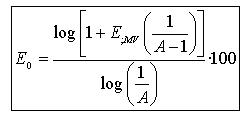
In the case of the Murphree efficiency is constant in all plates in conditions in which the operating line and equilibrium curves are straight, this efficiency can be calculated analytically using the equation:
Where:
A: absorption factor.